
Placement of suburethral strips (TOT/TVT)
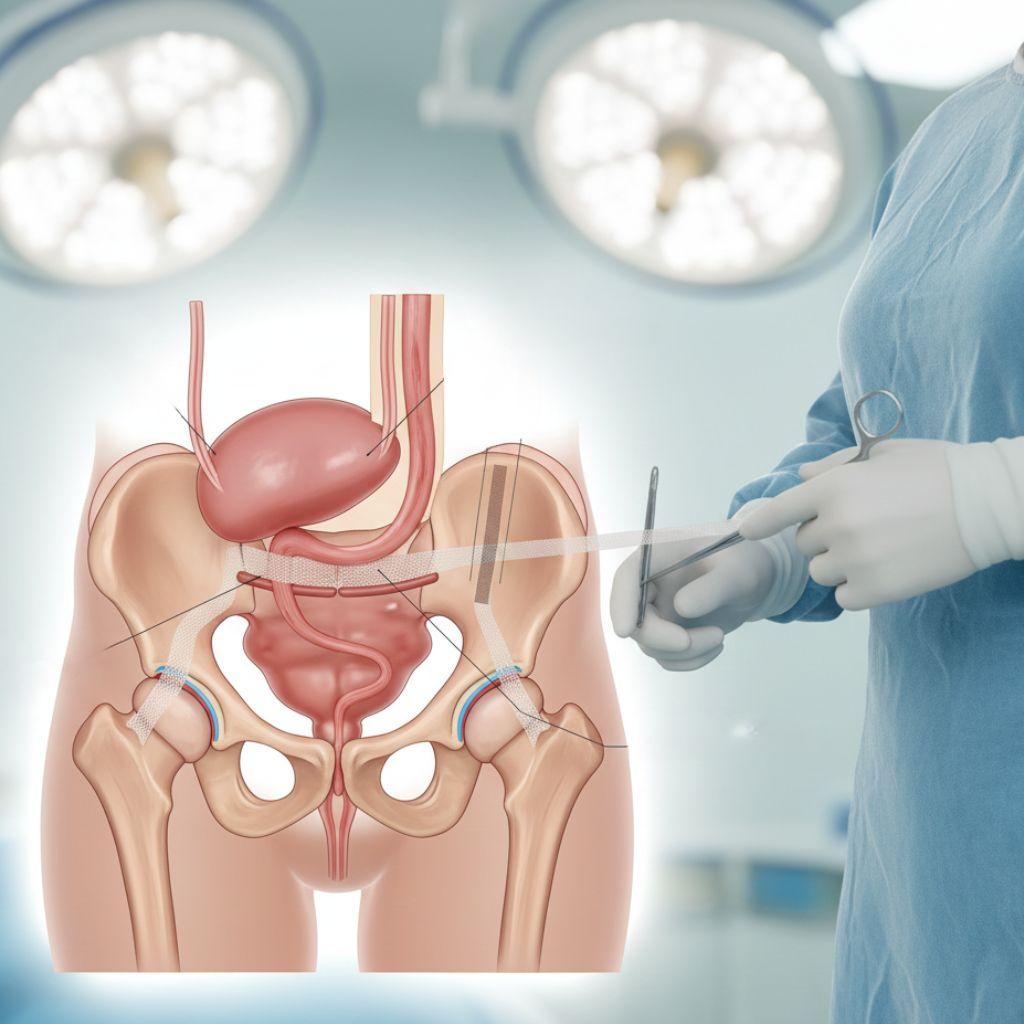
What is this gesture?
Suburethral sling surgery is a minimally invasive surgical technique designed to correcturinary stress incontinence in women (and in some cases in men).
It is designed to support the urethra so that it can remain closed during effort (coughing, sneezing, sport, etc.).
The band acts like a “hammock” under the urethra: it is not under tension at rest, but provides mechanical support when intra-abdominal pressure increases

In which cases?
Indications
When can this technique be offered?
- Persistent stress urinary incontinence despite well-managed perineal rehabilitation.
- Stress-induced bladder weakness that interferes with daily or social activities (sports, laughing, coughing, sneezing).
- Patients requiring a durable, minimally invasive solution, with rapid return to normal activities.
- Discussed in cases of moderate to severe incontinence if criteria are met (clinical examination, urodynamic assessment, sterile urine, etc.).
Surgical technique
Here’s how a strip is typically applied:
1️⃣ Pre-operative preparation
- Urodynamic assessment to confirm type of incontinence (stress).
- Urinalysis to ensure absence of infection.
- Anesthesia consultation; choice of anesthesia (local, locoregional or general) depending on the patient and surgeon.
2️⃣ Possible approaches
- Retropubic approach (TVT – Tension-free Vaginal Tape): tape inserted through a vaginal incision, ends pass behind the pubis.
- Trans-obturator approach (TOT): tape inserted via vaginal incisions and exiting at the sides (thigh fold), avoiding the retropubic space.
3️⃣ Strip implantation
- Small vaginal incision (a few centimetres) under the urethra.
- Passage of the strip (synthetic mesh, usually polypropylene).
- Tension-free” positioning: the strip is placed loosely under the urethra, neither too tight (risk of retention) nor too loose (ineffective).
4️⃣ Duration, hospitalization, aftercare
- The procedure usually takes 20 to 30 minutes.
- Hospitalization often on an outpatient or very short-term basis (day or night).
Rapid return to normal activities, sometimes as early as the next day or within a few days, depending on the surgeon’s instructions.
Advantages of the minimally invasive technique
✔ Less postoperative pain than more invasive surgeries.
✔ Reduced, often inconspicuous scars.
✔ Quick return to everyday activities.
✔ Very good success rate for stress leakage, especially in well-selected patients.
Risks and limits
As with any surgical procedure, there are risks and limitations to suburethral sling placement:
- Risk of post-operative urinary retention, if there is excess tension.
- Sensation of discomfort or pain in the groin or thigh with certain routes (TOT).
- Risk of infection, strip erosion, or urinary or vaginal complications.
- Limitations in cases of emergency-dominant mixed incontinence, or if support tissues are severely lacking, or in patients with complex surgical histories.
Alternatives or associated gestures
- Intensive perineal rehabilitation before or after surgery.
- Medication or behavioral treatments for urgent components.
- Autologous support bands or non-synthetic techniques, depending on profile.
- More extensive surgery in cases of previous surgery or associated prolapse.
Specialist in sub-uterine tape installation
Prof. François Haab will support you with a personalized approach: rigorous patient selection, assessment of benefits vs. risks, transparent information.
✔ Proven experience in female urological surgery, including suburethral sling techniques.
✔ Mastery of minimally invasive techniques, TVT and TOT, with a focus on comfort, safety and long-term results.
✔ Diligent follow-up, careful post-operative care and adaptation according to progress.
My journey in video
I made this video to introduce myself and describe my background and expertise.
Make an appointment
I welcome you to my Paris practice to discuss your expectations and propose the most appropriate solution: medical penoplasty or surgical penoplasty.